
JavaScript has risen as a dominant programming language in modern web development, owing to its remarkable versatility and capability to craft dynamic and interactive web applications.
Among the various features JavaScript offers, arrow functions have gained immense popularity among professionals and developers alike.
JavaScript arrow functions were introduced in ECMAScript 6 (ES6) and have quickly become a staple in JavaScript codebases due to their concise syntax, lexical scoping, and implicit returns.
In the following discussion, we will delve into the fundamental characteristics and benefits of arrow functions, uncovering their status as an indispensable asset within the arsenal of proficient developers.
What are JavaScript Arrow Functions?
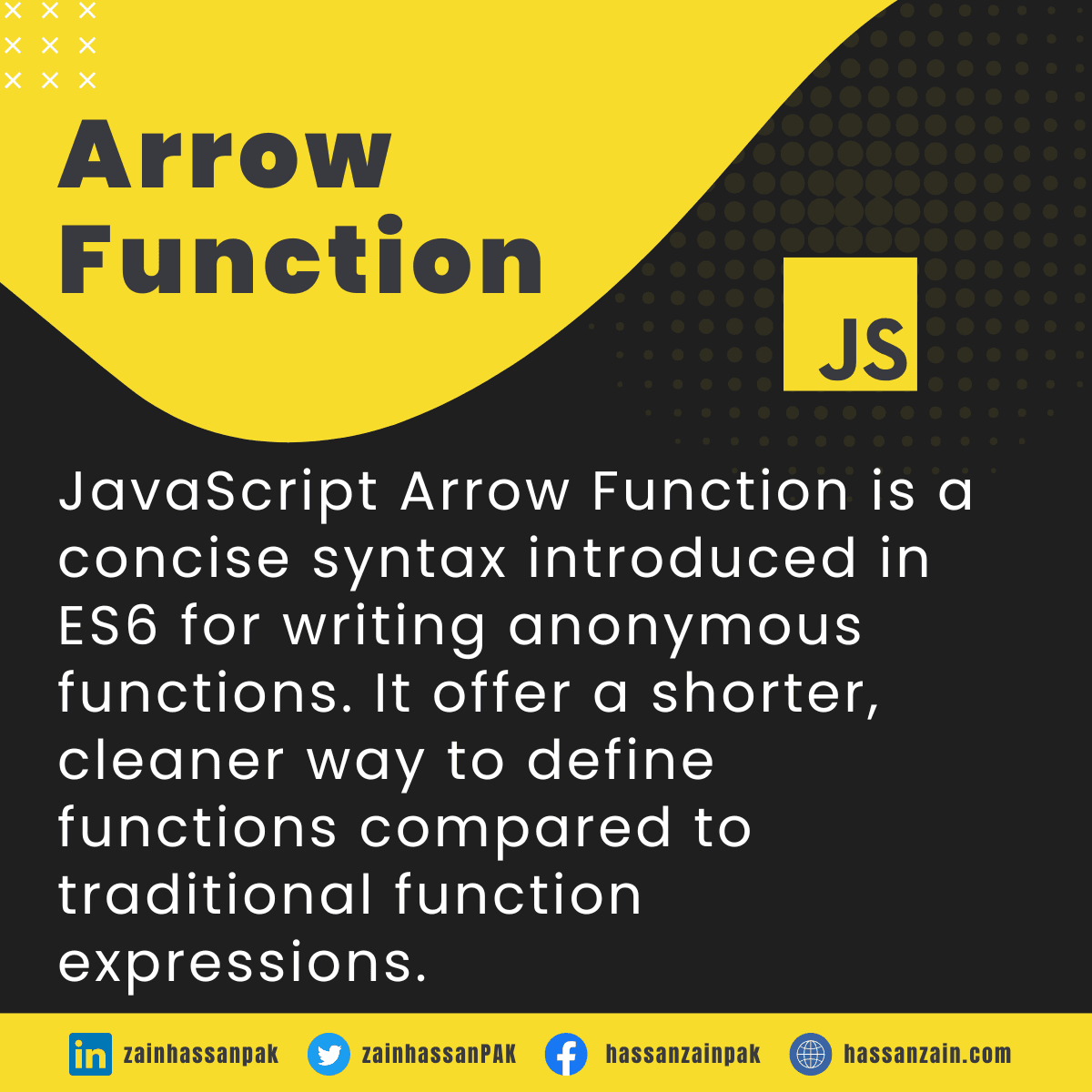
JavaScript Arrow Function is a concise syntax introduced in ES6 for writing anonymous functions. They offer a shorter, cleaner way to define functions compared to traditional function expressions.
Arrow Functions are well-suited for callbacks and event handlers since they inherit the enclosing this context. Their prevalence in contemporary JavaScript development is attributed to their readability and efficiency.
// Traditional Function Expression
function add(x, y) {
  return x + y;
}

// Arrow Function
const add = (x, y) => x + y;
Concise Syntax:
The concise and streamlined syntax of arrow functions stands out as a primary advantage. Traditional JavaScript functions require the ‘function’ keyword, parentheses for parameters, and explicit ‘return’ statements for single expressions.
In contrast, JavaScript arrow functions allow developers to omit the ‘function’ keyword and curly braces for single statements. This simplicity reduces boilerplate code and enhances code clarity, especially when dealing with short, one-liner functions.
function square(x) {
  return x * x;
}
Implicit Return:
Arrow functions offer implicit return for single expressions, further reducing verbosity. In situations where the function consists of a single statement, the value of that statement is automatically returned without requiring an explicit ‘return’ statement.
const add = (a, b) => a + b;Ideal for Callbacks:
Arrow functions excel as callbacks, especially in situations where brevity and code clarity are essential. Their concise syntax renders them ideal for event handlers and array methods such as ‘map,’ ‘filter,’ and ‘reduce.’
const numbers = [1, 2, 3, 4];
const squaredNumbers = numbers.map((num) => num * num);
console.log(squaredNumbers); // Output: [1, 4, 9, 16]
Lexical Scoping and ‘this’ Keyword:
An essential advantage offered by arrow functions is their ability to maintain lexical scoping. Unlike regular functions, JavaScript arrow functions do not bind their own ‘this’ context but instead inherit the ‘this’ value from the surrounding scope.
This behavior resolves the common issue of losing the context of ‘this’ inside nested functions or callbacks, making it easier for professionals to handle complex scenarios and maintain a clear understanding of variable scope.
For instance, in the context of event handlers or asynchronous functions, traditional functions often require additional workarounds, such as assigning ‘this’ to another variable or using the ‘bind()’ method.
In contrast, JavaScript arrow functions naturally retain the correct ‘this’ context, reducing potential bugs and improving code clarity.
function Person() {
  this.age = 0;
  setInterval(function growUp() {
    this.age++; // 'this' refers to the global object, not Person
  }, 1000);
}
Functional Programming Paradigm:
Arrow functions are particularly well-suited for functional programming paradigms, enabling developers to write more declarative and expressive code.
In functional programming, it is common to use higher-order functions like ‘map’, ‘filter’, and ‘reduce’ to process data immutably. JavaScript arrow functions complement this approach by providing a more concise and readable syntax for creating inline callbacks.
const numbers = [1, 2, 3, 4, 5];
const squaredNumbers = numbers.map((x) => x * x);
No Binding of ‘arguments’:
One additional benefit of arrow functions is that they do not create their own arguments object binding. The arguments object in traditional functions contains all the arguments passed to the function.
This may result in unforeseen behavior and introduce bugs, especially in intricate codebases. With JavaScript arrow functions, you can avoid such issues altogether.
Advantages of Arrow Functions:
Concise Syntax:
Arrow Functions replace the requirement for explicit function and return keywords, leading to more concise and cleaner code.
Lexical this Binding:
Arrow Functions differ from traditional functions by lacking their own this context. Instead, they inherit the this value from the surrounding code through “lexical scoping.” This behavior alleviates the need to use bind() or create workarounds to access the correct this context in nested functions
Implicit Return:
Arrow Functions automatically return the result when they have a single expression in their body, eliminating the need for developers to write explicit return statements. This feature enhances code readability and reduces boilerplate code.
Ideal for Short Functions:
Arrow Functions work best when used for short, single-line functions, making them a go-to choice for callbacks and event handlers.
Conclusion:
JavaScript arrow functions have revolutionized the way developers write and structure their code. With a succinct and intuitive syntax, they promote readability and maintainability.
Moreover, their lexical scoping mechanism ensures the correct handling of ‘this’, eliminating the need for workarounds in complex scenarios.
Additionally, their alignment with functional programming principles makes them invaluable in creating expressive and declarative code.
As professionals, adopting arrow functions in our JavaScript projects enhances our ability to produce efficient, elegant, and maintainable code, ultimately leading to a more successful development experience.
Incorporating arrow functions into our codebase is a significant stride towards crafting more elegant and expressive JavaScript, elevating our proficiency to new heights.